
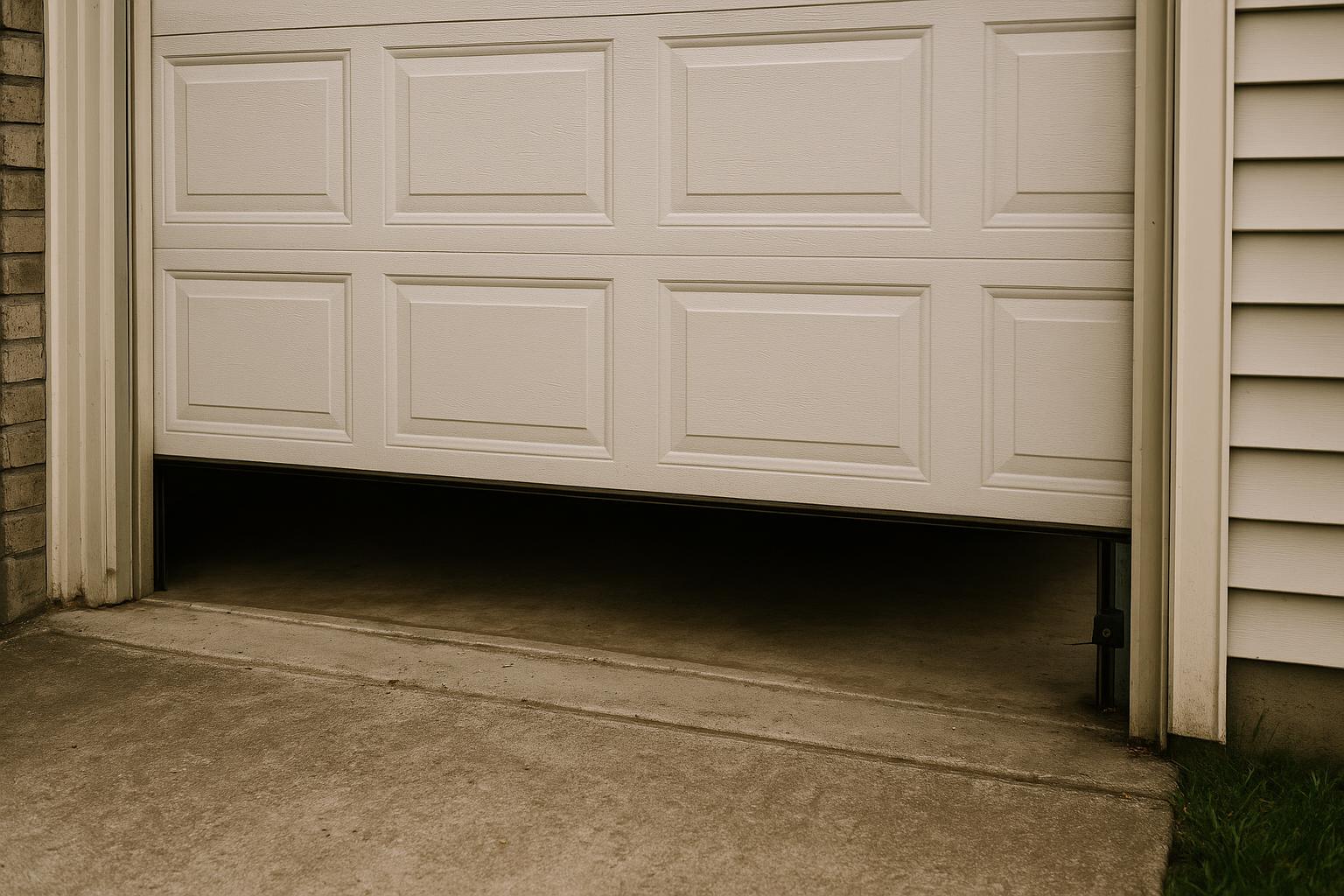
That Frustrating Reverse: What's Going On?
You press the button on your garage door remote. The door starts its descent, gets partway down — maybe even almost touches the floor — and then reverses right back up. You try again. Same thing. Maybe you try holding the wall button, and it works, but only while you keep your finger pressed down.
This is one of the most common garage door complaints we hear from homeowners in Gaithersburg, and the good news is that it's usually fixable without replacing the entire system. The tricky part is figuring out which of several possible causes is behind the problem. Let's walk through them one by one.
The Safety Sensors Are Blocked or Misaligned
This is the number one reason garage doors reverse before closing, and it's the first thing we check on every service call. Since 1993, federal law has required all automatic garage door openers to include photo-eye safety sensors — those small devices mounted near the bottom of your door tracks on either side.
These sensors send an invisible infrared beam across the opening. If anything breaks that beam — a trash can, a bicycle tire, a leaf, even a spiderweb — the opener interprets it as an obstruction and reverses the door to prevent injury or damage.
What to Check
- Obstructions: Look for anything in the path between the two sensors. Even something small can trigger a reversal.
- Dirty lenses: Wipe the sensor lenses with a soft cloth. Dust, cobwebs, and grime build up over time, especially in garages that see a lot of use.
- Alignment: Each sensor has a small LED light. If one is blinking instead of glowing steadily, it's likely out of alignment. Gently adjust the sensor bracket until the light holds steady. Both lights should be solid — usually green on the receiving sensor and amber on the sending sensor, though colors vary by brand.
- Sun interference: In Gaithersburg, afternoon sun can shine directly into a sensor and overwhelm the infrared signal. A small shade or cardboard tube around the sensor lens can solve this seasonal issue.
The Close-Force Setting Needs Adjustment
Your garage door opener has a setting that controls how much force it uses when closing the door. If this setting is too low, the opener may interpret normal resistance — like the weight of the door itself or slight friction in the tracks — as an obstruction and reverse.
Most openers have adjustment screws or dials on the back or side of the motor unit, often labeled "close force" or "down force." Turning the close-force dial slightly (usually a quarter turn at a time) can solve the problem. However, be careful not to set it too high, as this can override the safety features that protect people and property.
If you're not sure where the adjustment controls are, your owner's manual will have a diagram. If you've lost the manual, most manufacturers have PDFs available online by model number.
The Travel Limit Is Set Incorrectly
The travel limit tells your opener how far the door should move before it considers itself fully closed. If the "down" travel limit is set too far, the door hits the ground and keeps trying to push, which the opener reads as resistance and triggers a reversal.
This commonly happens after a spring replacement or when a new opener is installed and the limits aren't fine-tuned. Adjusting the down-limit switch — again, usually a small screw or dial on the opener unit — tells the motor exactly where to stop. Small adjustments make a big difference here.
Worn or Broken Springs
Your garage door springs do the heavy lifting — literally. They counterbalance the weight of the door so the opener motor doesn't have to work as hard. When springs wear out or break, the door becomes significantly heavier for the opener to move.
If your springs are weakening, the opener may struggle on the way down, sense excessive resistance, and reverse. You might also notice the door feels unusually heavy if you try to lift it manually, or it slams down faster than normal when disconnected from the opener.
Spring replacement is not a DIY job. Garage door springs are under extreme tension and can cause serious injury if handled incorrectly. This is one repair where calling a professional is always the right move. Our team handles spring replacements throughout Gaithersburg, Rockville, Germantown, and surrounding areas, and we always recommend letting a trained technician handle this work.
Track Problems and Roller Issues
Bent tracks, worn rollers, or debris in the track can create enough friction to trigger a reversal. Run your eye along both vertical tracks and the horizontal tracks near the ceiling. Look for dents, bends, or gaps between the track and the rollers.
Worn nylon or steel rollers can also cause the door to bind at certain points during travel. If the door reverses at the same spot every time, a track or roller issue is a strong possibility.
Quick Inspection Tips
- Check that the tracks are plumb (vertical sections) and level (horizontal sections).
- Look for loose brackets or hardware that may have shifted over time.
- Listen for grinding, scraping, or popping sounds during operation — these often point to roller or track problems.
The Opener Itself May Be Failing
If you've checked the sensors, adjusted the force and limit settings, and inspected the mechanical components, the issue could be with the opener's logic board or motor. Openers don't last forever — most have a lifespan of 10 to 15 years, depending on usage and maintenance.
Signs that your opener may be reaching the end of its life include intermittent operation, unusual humming or buzzing without movement, and inconsistent responses to the remote or wall button. At that point, replacement is often more cost-effective than repeated repairs, especially with newer models offering improved safety features, quieter operation, and smartphone connectivity.
When to Call a Professional
Some of these fixes — cleaning sensors, checking for obstructions, minor force adjustments — are safe for most homeowners to handle. But if the problem persists after basic troubleshooting, or if it involves springs, tracks, or opener internals, it's time to call in a pro.
At Gaithersburg Garage Door Service, we diagnose reversing issues quickly because we've seen hundreds of them. We'll tell you exactly what's wrong, explain your options in plain English, and get your door working properly — usually in a single visit. We serve homeowners and businesses across Gaithersburg, Derwood, North Potomac, Potomac, and the surrounding communities.
Prevent Future Problems with Regular Maintenance
Most reversing issues don't happen overnight. They develop gradually as components wear, settings drift, and small problems go unnoticed. An annual garage door maintenance visit can catch these issues early, saving you the frustration of a door that won't close — especially on a cold Maryland morning when you're trying to get to work.
A typical maintenance visit includes lubricating moving parts, testing the balance and safety features, tightening hardware, inspecting springs and cables, and making any necessary adjustments to your opener settings. It's a small investment that extends the life of your entire garage door system.
If your garage door is reversing and you can't figure out why, give us a call. We'll get to the bottom of it and have your door closing the way it should.